
Eurasian Watermilfoil
Invasive Eurasian Watermilfoil (Myriophyllum spicatum)
The invasive aquatic plant, Eurasian watermilfoil (EWM), has established itself in parts of the NE Arm of Lake Temagami. It forms dense mats that make it difficult to swim, paddle, and boat. This invasive plant also harms and kills native aquatic species by crowding them out, reducing biodiversity, and deoxygenating water when decomposing. It is disseminated primarily when plant fragments are transported on boat hulls and engines
It is almost impossible to completely eradicate EWM, and in some areas with very high levels of infestation, property values have dropped.
Resources on Eurasian Watermilfoil:
- Aquatic Plants: Federation of Ontario Cottagers’ Associations (FOCA)
- Eurasian Watermilfoil: Invasive Species Centre
- The Threat of Eurasian Watermilfoil: Temagami Times, Fall 2025, page 5
What You Need to Know:
- Learn how to identify invasive EWM and prevent its introduction or spread in Ontario’s waterways.
- It is illegal to:
- possess or transport EWM in a provincial park or conservation reserve
- bring this invasive aquatic plant into Ontario
- deposit, release, or propagate EWM (including planting it, or any other actions which may encourage its spread or growth)
- buy, sell, lease, or trade EWM in Ontario
- Never keep or grow EWM in an aquarium, water garden, or for any other purpose.
- Always clean, drain, and dry your watercraft before transporting it to another waterbody.
- As of January 1, 2022, boaters must open or remove boat drain plugs and other devices to allow water to drain. They must also take reasonable measures to remove plants, animals, and algae from their watercraft, watercraft equipment, and boat trailers before transporting them overland.
- Boaters must ensure watercraft, watercraft equipment, and boat trailers do not have aquatic plants, animals, or algae attached to them before arriving at a launch site or placing the watercraft into any waterbody.
Source: Ontario.ca website
Identifying Eurasian Watermilfoil (Myriophyllum spicatum):
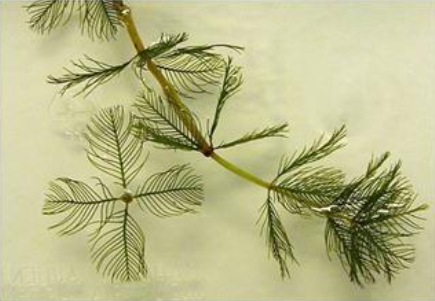
Source: USGS, 2018 (via Wikimedia Commons)
.png)
There are many types of watermilfoils. The concern is with the invasive variety – Eurasian watermilfoil – which has these features:
- It has more than 12 leaflet pairs per stem. Other species have 5 to 10 pairs.
- When EWM is pulled from the water, the leaflets hang limply. When Northern watermilfoil (the native version) is out of the water, the leaflets are rigid.
- EWM has pale or pinkish stems. Other species have pale, whitish-green stems.
- EWM tends to branch near the surface, and during July and August, reddish flowers form on the surface.
Is It Eurasian Watermilfoil?
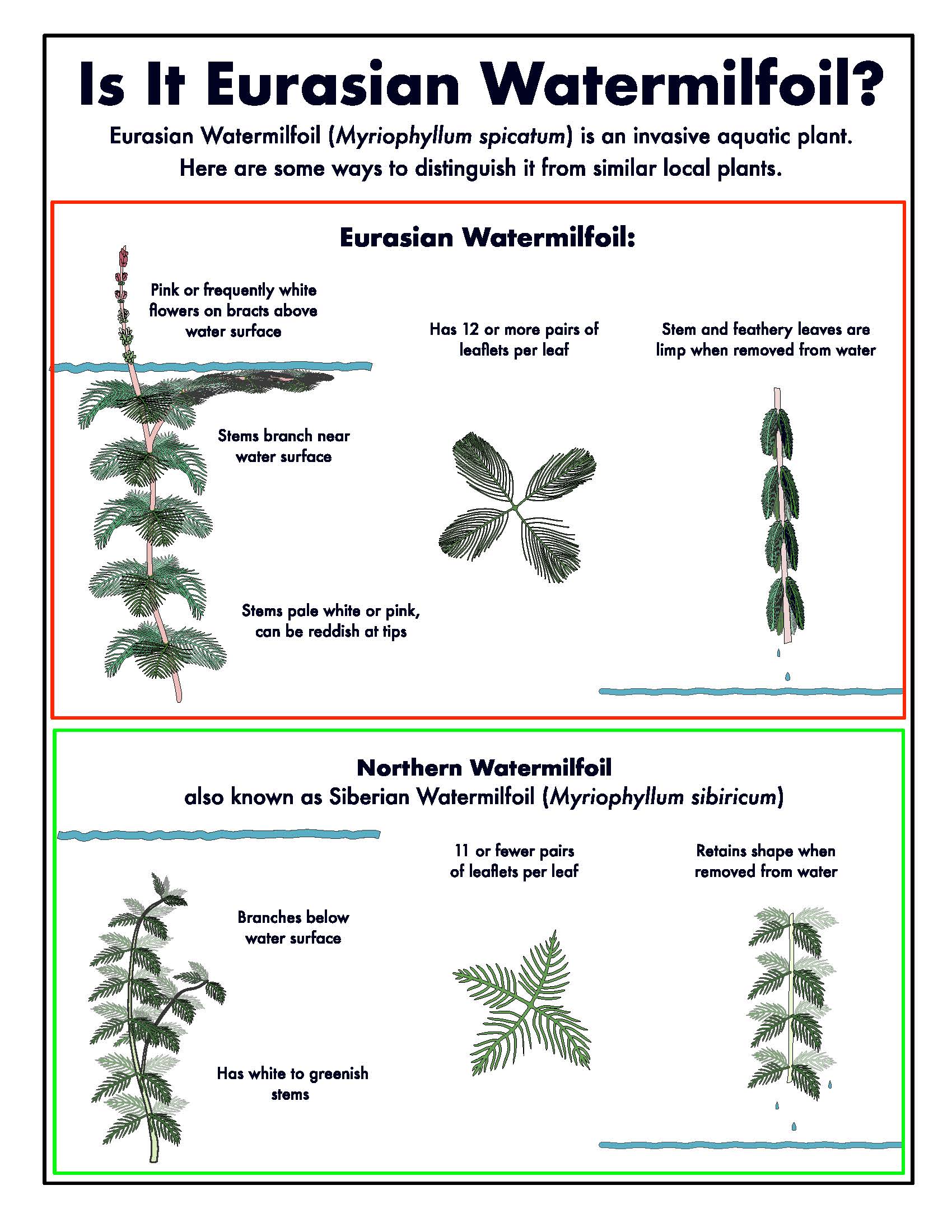
Public Domain Illustration by Tansy Brooks, 2026
Further resources for Identifying invasive and native watermilfoils:
- Myriophyllum: Wikipedia (2026)
- Myriophyllum: Michigan Flora (2026)
- Minnesota Wildflowers, search for myriophyllum: Minnesota Wildflowers (2026)
- Comparison of Invasive Eurasian Watermilfoil (Myriophyllum spicatum) and Native Northern Watermilfoil (Myriophyllum sibiricum): Glen Lake Association (2025)
- Milfoil (Myriophyllum Species) Identification Guide: Ornamental Aquatic Trade Association Ltd. (2023)

Where Has Eurasian Watermilfoil Been Found in the Temagami Area?
As of July 2026, a formal survey by Fyto (https://fyto.ca) identified EWM in the Northeast Arm of Lake Temagami at the Townsite and Finlayson Point Provincial Park (see map below). EWM was not, however, found near the Access Road Landing and Boatline Bay during this same survey.
The EDDMapS website shows reported sightings of EWM. Just zoom into Lake Temagami at: www.eddmaps.org/distribution/viewmap.cfm?sub=3055&lat=%20%2042.46276&lng=%20-88.13447&zoom=14 .
The iNaturalist app may be used, as well, to identify and report sightings of EWM: www.inaturalist.org/taxa/60207-Myriophyllum#map-tab.
EDDMapS utilizes both data from iNaturalist and from users. It also has an app called EDDMapS Pro that can be used without an internet connection.
Please watch for EWM (and other aquatic invasive species), and report suspected sightings to the TLA. E-mail the location (with photos) to temagami-invasives@lists.sonic.net and temagamilakes1931@gmail.com.